How Long Do Praying Mantis Live? Lifespan by Stage and Species
A praying mantis perched motionless on a leaf, head tilted, looks like it could live for years, but its actual lifespan is far shorter than that calm posture suggests. Most species complete their entire life cycle within about a year, moving through distinct stages that each come with their own risks and timeline.

Our bug identifier tool can confirm exactly which mantis species you are looking at from a photo, which matters since lifespan and care needs vary slightly between species.
This article walks through how long a praying mantis lives at each stage, from egg to adult, and what actually determines whether an individual mantis lives closer to the short end or the long end of that range. It also covers what affects lifespan specifically for anyone keeping a mantis as a pet, along with the key differences between a Chinese mantis and other commonly kept species.
The Life Cycle of a Praying Mantis
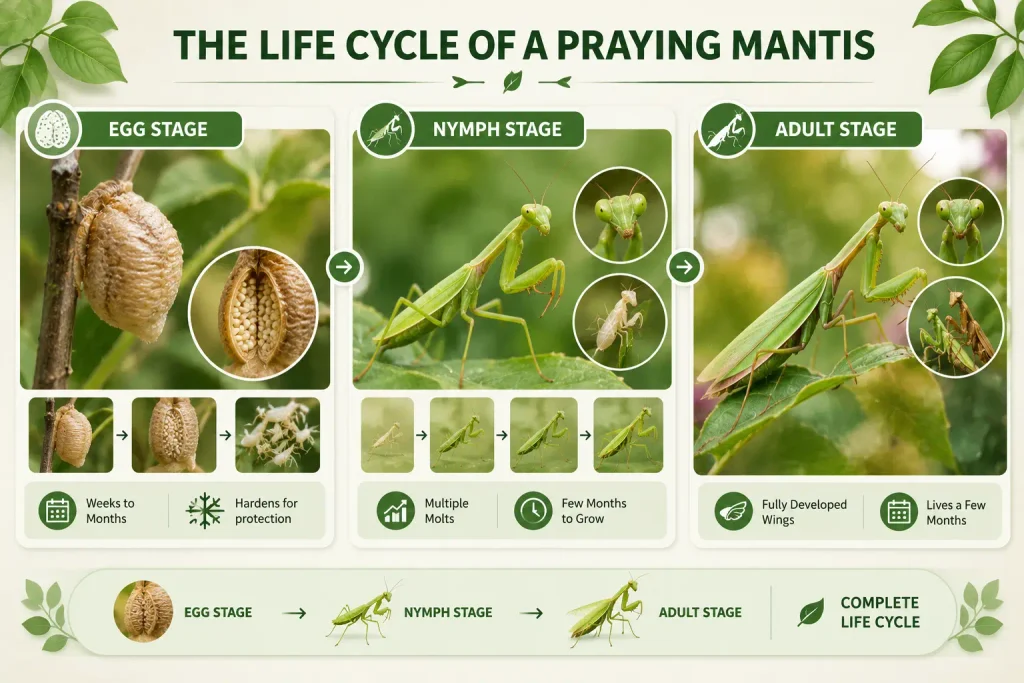
Egg Stage
A female mantis lays her eggs inside a foam-like case called an ootheca, which hardens to protect the eggs through the colder months or dry season, depending on the region. This egg stage typically lasts several weeks to a few months, with hatching timed to coincide with warmer weather and increased insect activity that will support the newly hatched nymphs.
Nymph Stage
Once hatched, young mantises emerge as nymphs, miniature versions of the adult form without functional wings, and immediately begin hunting small insects to fuel rapid growth. Nymphs molt several times over a period of a few months, shedding their exoskeleton at each stage as they gradually increase in size and develop toward their adult form.
Adult Stage
After the final molt, a mantis reaches adulthood with fully developed wings and reproductive maturity, typically living for a few months as an adult before its natural lifespan ends. This adult stage is when mating occurs, and for many species, it also marks the point where lifespan differences between males and females become most apparent.
Wild Lifespan vs Pet Lifespan
In the wild, a praying mantis faces constant threats from predators, weather, and food scarcity, all of which can shorten its lifespan considerably compared to the theoretical maximum for its species. Birds, spiders, and even other mantises pose a real risk, particularly during the vulnerable nymph stage when a mantis is smaller and less capable of defending itself. Curious about their diet? See what ladybugs eat for a comparison with other beneficial insects.
Mantises kept as pets, with consistent food, stable temperatures, and no natural predators, often live closer to the upper end of their species’ potential lifespan. This more controlled environment removes many of the unpredictable risks that cut a wild mantis’s life short, though captivity introduces its own set of care requirements that need to be met consistently.
What Affects a Praying Mantis’s Lifespan
Temperature plays a significant role, since mantises are cold-blooded and rely on their environment to regulate metabolism, meaning consistently cool conditions can slow growth and shorten overall lifespan. Diet quality and consistency matter just as much, since irregular feeding or a diet lacking variety can weaken a mantis and make it more susceptible to illness or early death.
Molting complications present a genuine risk at every nymph stage, since a failed or incomplete molt can injure or kill a mantis outright, particularly if humidity levels are not properly maintained. For adults, especially males, mating itself carries a real risk, since sexual cannibalism, though not universal across every encounter, does shorten the expected lifespan of males in several commonly kept species.
What Praying Mantises Eat
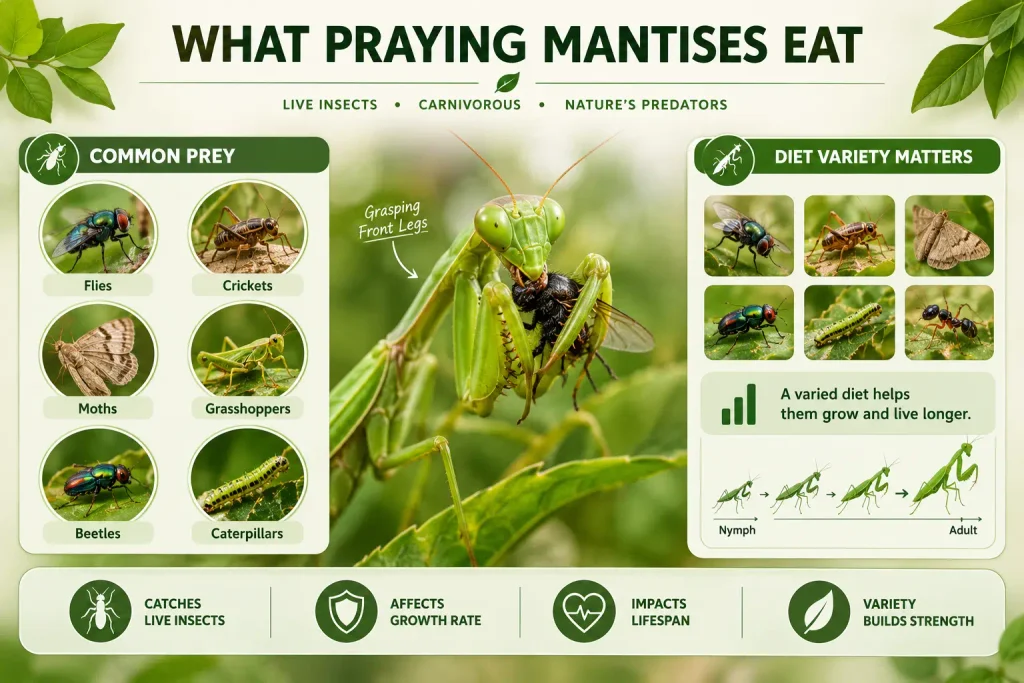
Mantises are exclusively carnivorous, feeding on live insects like flies, crickets, moths, and other invertebrates they catch using their fast, grasping front legs. Diet directly affects lifespan and growth rate, since a mantis fed a varied, appropriately sized diet grows more reliably through each nymph stage than one fed inconsistently or with prey too large or too small for its current size.
Larger adult mantises of certain species have been known to occasionally catch small vertebrates like tiny lizards or hummingbirds, though insects make up the overwhelming majority of any mantis’s actual diet. For anyone keeping a mantis as a pet, matching prey size to the mantis’s current stage, roughly the length of its abdomen, helps prevent both injury from oversized prey and malnutrition from an inadequate diet. You might also wonder if insects sleep the way other animals do.
Where Praying Mantises Live
Praying mantises are found across a wide range of climates, favoring gardens, tall grass, shrubs, and agricultural areas where insect prey is abundant. Their green or brown coloring provides camouflage against leaves and stems, allowing them to remain motionless while waiting for prey to come within striking range.
Species distribution varies considerably, with some mantises adapted to warmer, more humid climates and others tolerating cooler, more temperate conditions with a shorter active season. This habitat flexibility is part of why mantises are found in gardens and natural areas across so many different regions, each supporting slightly different species with their own specific lifespan tendencies.
Tips for Maximizing a Pet Mantis’s Lifespan
Maintaining appropriate temperature and humidity for the specific species being kept is one of the most important factors, since inconsistent conditions increase the risk of failed molts and general poor health. Providing a varied diet of appropriately sized live insects, fed on a consistent schedule, supports steady growth and reduces the stress associated with irregular feeding.
Giving a mantis enough vertical space to molt safely, ideally at least three times its body length in enclosure height, prevents injuries that commonly occur when a mantis lacks room to hang and shed its exoskeleton properly. Minimizing unnecessary handling, particularly during and immediately after a molt when the exoskeleton is still soft, also reduces the risk of accidental injury that could shorten an otherwise healthy mantis’s lifespan.
Chinese Mantis vs Praying Mantis: What Is the Difference
Chinese Mantis
The Chinese mantis is a specific, larger species, often reaching four to five inches in length, with a light brown to green coloring and a distinctive green stripe along the edges of its wings. It was introduced to several regions outside its native range and has since become one of the most commonly encountered mantis species due to its size and adaptability.
Praying Mantis
“Praying mantis” is a broader common name covering the entire mantis order, which includes hundreds of species beyond the Chinese mantis specifically. Native mantis species tend to be somewhat smaller and can vary significantly in color and pattern depending on their specific habitat and region, making accurate identification more useful than assuming every mantis encountered belongs to the same species.
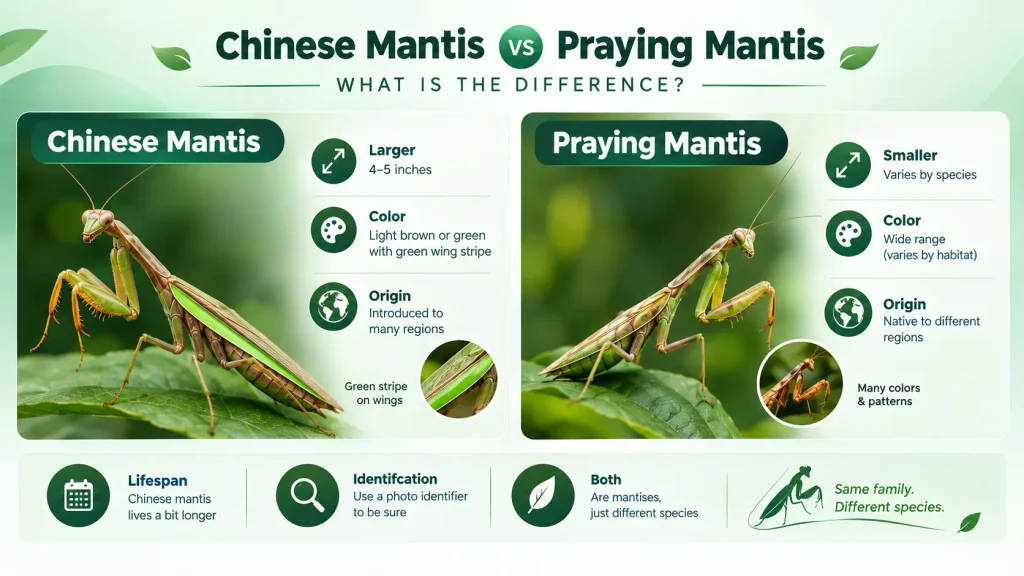
Lifespan expectations differ slightly between species, with larger species like the Chinese mantis sometimes living a bit longer than smaller native species due to their size advantage during the vulnerable nymph stage. Running a photo through an identifier tool clarifies exactly which species is present, which helps set realistic lifespan and care expectations rather than relying on general assumptions.
Common Mistakes When Caring for a Praying Mantis
Feeding prey that is too large for a mantis’s current size is one of the most frequent mistakes, since oversized prey can injure a mantis during a struggle rather than providing an easy meal. Neglecting humidity requirements during molting is another common issue, since dry conditions significantly increase the risk of a failed molt that can prove fatal.
Handling a mantis too frequently, especially during its softer, more vulnerable post-molt period, raises the risk of accidental injury that a more hands-off approach would avoid entirely. Assuming every mantis species has identical care needs and lifespan expectations also leads to avoidable mistakes, since size, native climate, and typical lifespan all vary meaningfully between species. Their life stages are just as fascinating as caterpillar cocoon duration.
Frequently Asked Questions
Conclusion
A praying mantis packs an entire life cycle, egg, nymph, and adult, into roughly a single year, with temperature, diet, and molting conditions all playing a real role in whether an individual lives closer to the short or long end of that range. Pet mantises kept with consistent feeding, proper humidity, and enough room to molt safely tend to live longer than their wild counterparts, who face constant predator and environmental pressure. Knowing the specific species involved, whether it is a Chinese mantis or one of the many other commonly encountered species, helps set realistic expectations for both lifespan and care. Running a clear photo through our bug identifier tool confirms exactly which species you are looking at, turning general lifespan expectations into species-specific, genuinely useful guidance.