Tiny White Bugs on Plants: What They Are and How to Get Rid of Them
Discovering tiny white specks crawling, flying, or clustered on a favorite houseplant or garden vegetable is one of the more common plant care frustrations, and the cause behind those specks varies more than most people expect.
Our bug identifier tool can confirm exactly which one you are dealing with from a clear photo, which matters since treatment differs meaningfully between them.
This article breaks down every common cause of tiny white bugs on plants, how to tell them apart, and which treatment actually works for each one. It also covers the harder-to-answer questions competitors often skip: whether these bugs pose any risk to people or pets, why they keep coming back, and when a struggling plant is worth saving versus better off discarded entirely.
What Are Those Tiny White Bugs? A Quick Identification Overview
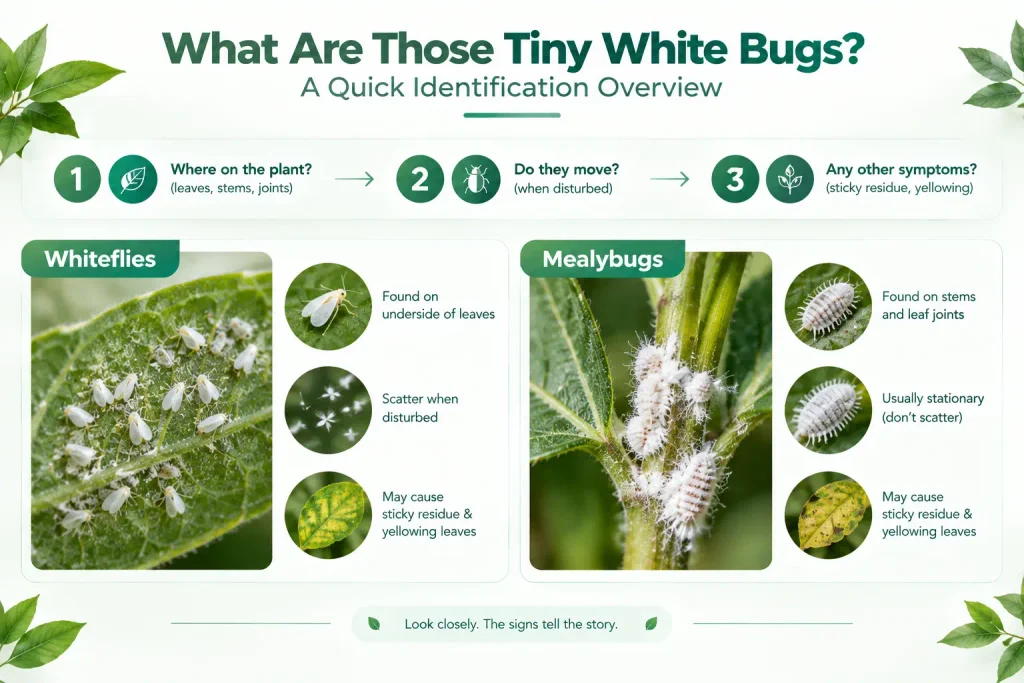
The fastest way to narrow down the cause is to note three things: where on the plant the bugs appear, whether they move when disturbed, and whether the plant shows any additional symptoms like sticky residue or yellowing leaves. Bugs clustered on the underside of leaves that scatter into flight when the plant is touched point strongly toward whiteflies, while a stationary, cottony white mass along stems and leaf joints suggests mealybugs instead.
Tiny white specks confined to the surface of the soil, rather than the plant itself, usually indicate either fungus gnat larvae, root aphids, or harmless springtails, each of which requires a different response. Checking these basic details before choosing a treatment saves time compared to applying a general pesticide that may do little against the specific pest actually present. Natural remedies here overlap with our guide on how to keep insects away naturally.
Whiteflies
Tiny white bugs on plants are most often whiteflies, mealybugs, certain aphid types, or thrips in their nymph stage, though fungus gnat larvae, root aphids, and harmless springtails also get mistaken for the same problem. Insecticidal soap, a strong water spray, and rubbing alcohol applied with a cotton swab handle most of these pests effectively when applied consistently over one to two weeks. None of these pests are harmful to people or pets, though a few can carry plant diseases between infected and healthy plants if left untreated.
What They Look Like
Whiteflies are small, moth-like insects with powdery white wings, typically found clustered on the undersides of leaves where they feed on plant sap. When a heavily infested plant is disturbed, adult whiteflies scatter into the air in a small cloud before quickly resettling on nearby leaves.
Symptoms
Affected leaves often develop a sticky residue called honeydew, a byproduct of whitefly feeding that can attract sooty mold and give leaves a dark, dusty appearance over time. Heavily infested plants may show yellowing, curling leaves and stunted growth as the population continues feeding and multiplying.
Controls
Yellow sticky traps placed near affected plants capture adult whiteflies effectively and also serve as an early warning system for monitoring population levels. Insecticidal soap applied directly to the undersides of leaves, where whiteflies feed and lay eggs, provides the most effective direct treatment when reapplied every five to seven days.
Aphids
What They Look Like
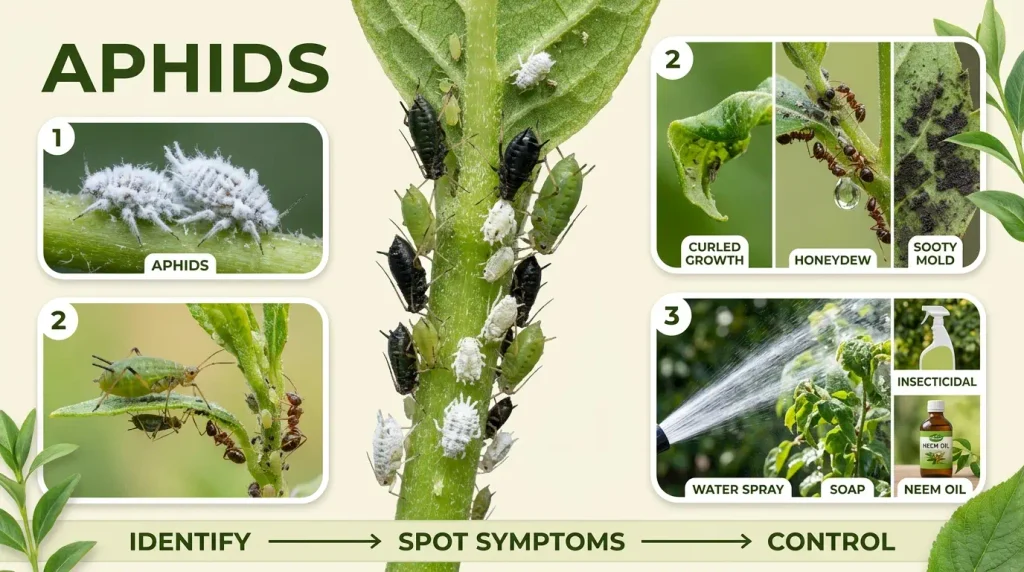
While aphids are more commonly green or black, certain species and life stages appear pale white or waxy, particularly woolly aphids, which produce a white, fuzzy coating that can resemble mold at first glance. Aphids cluster densely on new growth, stems, and the undersides of leaves rather than spreading evenly across a plant.
Symptoms
Aphid feeding causes curled, distorted new growth and the same sticky honeydew residue associated with whiteflies, often followed by sooty mold growth on affected leaves. Heavy infestations can significantly slow a plant’s growth and, in outdoor gardens, attract ants that protect aphids in exchange for the honeydew they produce.
Controls
A strong, direct spray of water dislodges a significant portion of an aphid population, particularly effective for isolated colonies on new growth. Insecticidal soap or neem oil applied thoroughly to affected areas provides a more complete treatment for persistent infestations that water alone does not fully resolve.
Mealybugs
What They Look Like
Mealybugs appear as small, oval insects covered in a white, cottony, wax-like coating, typically clustered in leaf joints, along stems, and on the undersides of leaves. Their distinctive fuzzy white appearance often gets mistaken for a fungal issue before closer inspection reveals the insects underneath. If beneficial insects are present too, learn what ladybugs eat — they may help control the problem.
Symptoms
Like whiteflies and aphids, mealybugs produce sticky honeydew that can lead to sooty mold, along with yellowing leaves and stunted growth in heavily affected plants. Mealybugs can also infest plant roots in soil, which is a less visible but equally damaging form of infestation that often goes unnoticed until a plant’s overall health declines.
Controls
Dabbing individual mealybugs directly with a cotton swab soaked in rubbing alcohol kills them on contact and works well for smaller, localized infestations. For larger populations, insecticidal soap applied thoroughly across the entire plant, including leaf joints and stems, combined with repeated applications every one to two weeks, provides more complete control.
Thrips
What They Look Like
Thrips are extremely small, slender insects that can appear pale yellow to white during their nymph stage before darkening as they mature into adults. They move quickly when disturbed and are often difficult to spot without a magnifying glass or a close, careful inspection of leaf surfaces.
Symptoms
Thrip feeding causes a distinctive silvery or stippled discoloration on leaves, along with small black specks of excrement visible under close inspection. Flowers and new growth are particularly vulnerable, often showing distorted development or premature dropping in heavily affected plants.
Controls
Yellow or blue sticky traps help monitor and reduce adult thrip populations, while insecticidal soap or neem oil applied to both leaf surfaces addresses nymphs and adults directly. Because thrips can hide in unopened buds and soil, a single treatment often needs to be repeated over several weeks to fully break their life cycle.
Scale Insects
Scale insects, particularly cottony cushion scale, produce a white, waxy covering that can look remarkably similar to mealybugs at first glance, though scale insects typically remain stationary once settled rather than moving around the plant. This waxy shell protects them from many contact sprays, making removal by hand or targeted treatment more effective than a general spray application.
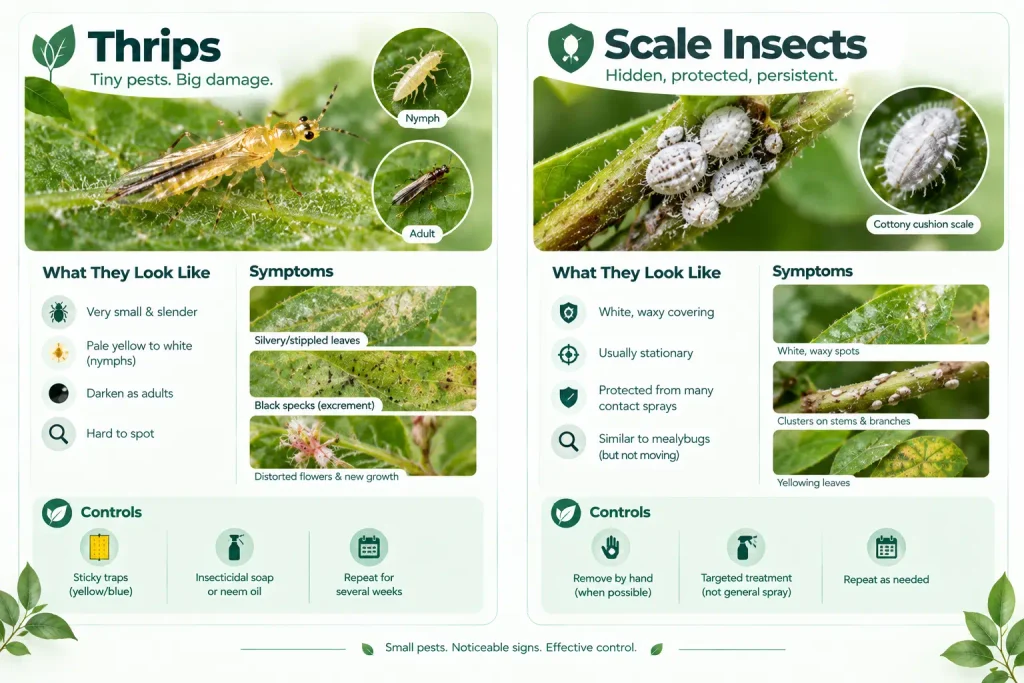
Gently scraping visible scale off with a soft brush or fingernail, followed by an application of horticultural oil to smother any remaining nymphs, addresses both visible and newly hatched scale insects. Because adult scale insects are largely immobile, monitoring for the mobile “crawler” stage, which is more vulnerable to treatment, offers a more effective window for intervention.
Fungus Gnats and Their Larvae
Fungus gnat adults are small, dark flying insects often mistaken for fruit flies, but their larvae appear as tiny, translucent to white worm-like creatures living in the top layer of moist soil. Unlike the pests covered above, fungus gnats primarily target overly damp soil and organic matter rather than the plant itself, though heavy larval populations can damage young roots.
Allowing the top inch or two of soil to dry out between waterings disrupts the moist conditions fungus gnat larvae depend on, often resolving a mild infestation without any additional treatment. For persistent problems, a layer of diatomaceous earth on the soil surface or a specific soil drench labeled for fungus gnat larvae provides more direct control.
Root Aphids
Root aphids appear as small, white, waxy insects living on plant roots below the soil surface, often going unnoticed until a plant shows unexplained wilting or declining health despite adequate watering. Unlike the fungus gnat larvae they are sometimes confused with, root aphids feed directly on root tissue and produce the same waxy coating seen on their above-ground aphid relatives.
Confirming root aphids typically requires gently checking the root ball for visible white insects or a waxy residue, since above-ground symptoms alone are not distinctive enough for a confident diagnosis. Treatment usually involves repotting into fresh, sterile soil combined with a systemic insecticide, since topical treatments struggle to reach a below-soil infestation effectively.
Springtails: A Harmless Look-Alike
Springtails are tiny, white to gray insects that live in moist soil and organic matter, often noticed jumping or hopping when soil is disturbed or watered. Despite their unsettling appearance in large numbers, springtails are entirely harmless to plants and feed primarily on decaying organic matter and fungal growth rather than living plant tissue.
Their presence, particularly in large numbers, often indicates consistently overwatered soil rather than a pest problem requiring treatment, making reduced watering frequency the most effective and appropriate response. Confusing springtails with a more damaging pest can lead to unnecessary chemical treatment for a population that was never actually harming the plant.
Tiny White Bugs That Are Not Insects at All
Spider Mites (Technically Arachnids)
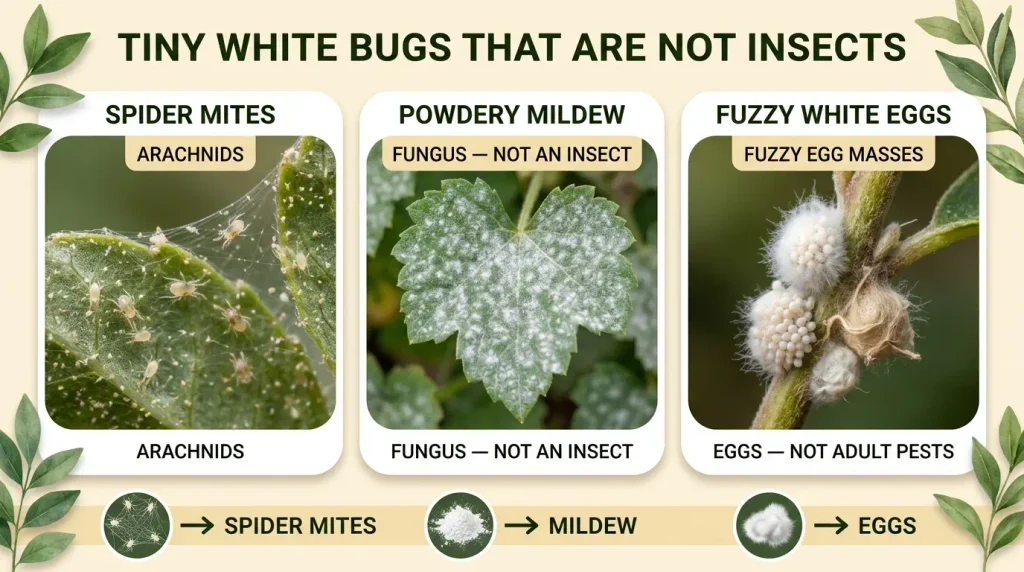
While spider mites themselves are usually too small to see clearly without magnification, their fine webbing and the tiny white specks of shed skin they leave behind are often mistaken for a separate insect problem. Checking the underside of affected leaves for extremely fine webbing helps distinguish a mite infestation from any of the true insects covered above. Seeing similar bugs indoors? Check our guide on small black bugs in the house.
Powdery Mildew
Powdery mildew is a fungal growth that appears as a white, dusty coating across leaf surfaces, easily mistaken for an insect infestation at a quick glance. Unlike an insect problem, powdery mildew spreads through fungal spores and responds to fungicidal treatment and improved air circulation rather than any insecticide.
Fuzzy White Eggs or Egg Sacs
Certain insects lay small, white, fuzzy egg masses that can be mistaken for the pest itself rather than its offspring, particularly with lacewing or some moth species. Correctly identifying an egg mass versus an active infestation changes the urgency and type of response needed, since eggs alone may not yet warrant aggressive treatment.
White Bugs on Leaves vs White Bugs in Soil
Bugs found exclusively on leaves and stems, like whiteflies, aphids, mealybugs, thrips, and scale insects, are actively feeding on plant tissue above the soil line and typically respond to foliar treatments like insecticidal soap or neem oil. Bugs found in or on the soil surface, including fungus gnat larvae, root aphids, and springtails, require a different approach focused on soil moisture management, soil-specific treatments, or, in the case of springtails, often no treatment at all.
This distinction matters significantly for choosing the right response, since a foliar spray does little against a root aphid infestation, and a soil drench provides no benefit against whiteflies feeding on leaf undersides. Identifying exactly where the bugs are concentrated is one of the most useful diagnostic steps before selecting any treatment method.
Life Cycle of Tiny White Bugs and Why They Keep Coming Back
Most of these pests reproduce quickly, with some species like aphids capable of producing new generations within a week under favorable conditions, which explains why a seemingly resolved infestation can rebound so fast. Eggs laid on leaf undersides or in soil often survive a single treatment application, hatching into a new generation before a plant owner even notices signs of recovery.
This rapid reproduction cycle is the primary reason most effective treatment plans call for repeated applications over two to three weeks rather than a single spray. Breaking the cycle requires addressing multiple generations as they hatch, rather than assuming one thorough treatment has eliminated every stage present on the plant.
How Tiny White Bugs Spread From Plant to Plant Indoors
Indoor plant pests spread primarily through direct contact between touching leaves, shared watering tools, or airborne adults like whiteflies and thrips capable of short flights between nearby plants. A single infested plant brought home from a nursery or received as a gift can introduce a pest population to an entire indoor plant collection within a matter of weeks if not caught early.
Isolating a new or suspected plant away from an existing collection for at least two weeks before integrating it fully allows any hidden infestation to become visible before it has a chance to spread. Regularly wiping down leaves and avoiding letting plants touch each other unnecessarily further limits how easily pests move between neighboring plants.
Are Tiny White Bugs Harmful to Humans or Pets
None of the common tiny white bugs covered in this article bite, sting, or pose any direct health risk to people or pets, making them exclusively a plant health concern rather than a household safety issue. Curious pets that chew on an infested plant are more likely to experience mild digestive upset from the plant itself, if it happens to be toxic, than from the insects present on it.
The treatments used to address these pests deserve more caution than the bugs themselves, since insecticidal soap, neem oil, and rubbing alcohol should be kept away from direct pet contact until fully dry. Checking a specific treatment product’s label for pet safety guidance before application keeps the process safe for the whole household.
How to Get Rid of Tiny White Bugs on Plants
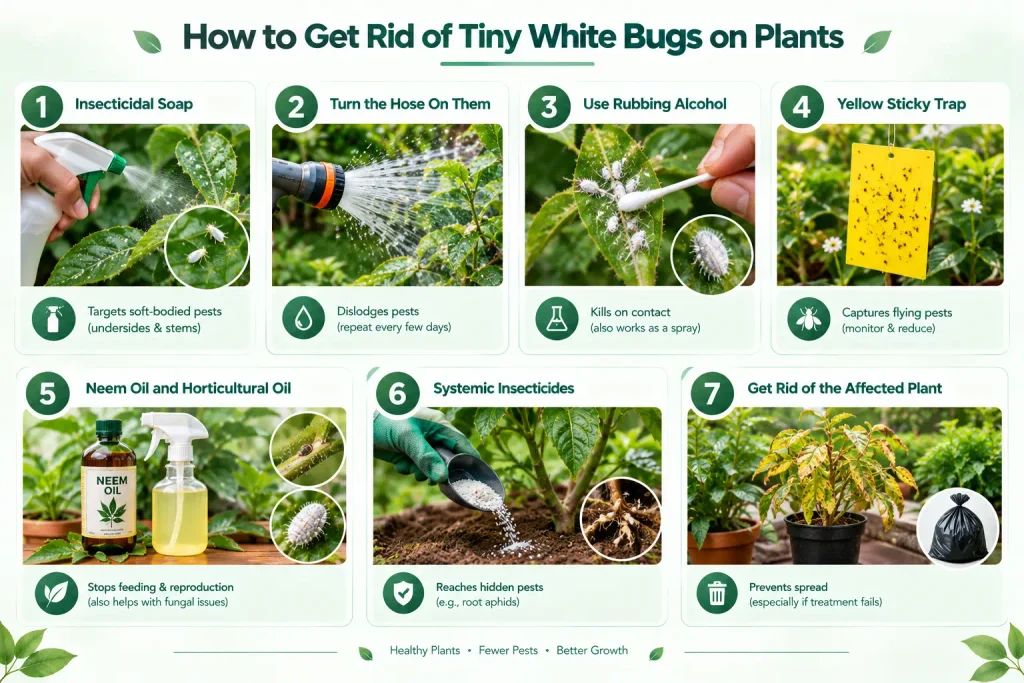
Insecticidal Soap
Insecticidal soap disrupts the outer protective coating of soft-bodied insects like aphids, whiteflies, and mealybugs, causing dehydration shortly after contact. Thorough coverage, including leaf undersides and stem joints where these pests concentrate, matters more for effectiveness than the specific product brand chosen.
Turn the Hose On Them
A strong, direct spray of water physically dislodges many soft-bodied pests from a plant, offering a chemical-free first response particularly effective against light aphid or whitefly populations. This method works best outdoors or over a sink, since it can be messy, and it often needs to be repeated every few days to catch newly hatched insects.
Use Rubbing Alcohol
Dabbing individual pests directly with a cotton swab soaked in rubbing alcohol kills mealybugs, scale insects, and aphids on contact, making it ideal for smaller, localized infestations. A diluted alcohol spray can also treat larger areas, though it should be tested on a small section of the plant first to check for any leaf sensitivity.
Use a Yellow Sticky Trap
Yellow sticky traps placed near affected plants capture flying adult pests like whiteflies and thrips, both reducing the active population and providing an easy way to monitor infestation levels over time. These traps work best as a complement to direct treatment rather than a standalone solution, since they do not address eggs or nymphs already on the plant.
Neem Oil and Horticultural Oil
Neem oil disrupts insect feeding and reproduction while also offering mild fungal protection, making it a versatile option for mixed pest and disease concerns on the same plant. Horticultural oil works particularly well against scale insects, smothering both the visible adults and the more vulnerable crawler stage.
Systemic Insecticides for Persistent Infestations
For severe or root-based infestations, particularly root aphids, a systemic insecticide applied to the soil is absorbed by the plant and provides protection from within, reaching pests that topical treatments cannot access. These products require careful attention to label instructions regarding safe use around edible plants, pets, and pollinator activity.
Get Rid of the Affected Plant
For a severely infested plant that has not responded to repeated treatment, particularly one located near several other healthy plants, removing and discarding it entirely may be the more practical choice. This decision, covered in more detail later in this article, prevents a persistent, resistant infestation from continuing to threaten an entire plant collection.
Best Time to Treat Tiny White Bugs
Early morning or evening treatment avoids the intense midday sun that can cause leaf burn when combined with insecticidal soap, neem oil, or horticultural oil applications. Cooler temperatures during these times also reduce the rate at which treatments evaporate before fully coating the target pests.
Applying treatment before pests are most active, typically early morning for many species, can improve contact effectiveness, though consistency in timing matters more than choosing one specific hour over another. Avoiding treatment during active bloom periods, when pollinators are most likely to visit, also helps minimize any unintended impact on beneficial insects visiting nearby flowers.
Preventing Tiny White Bugs Before They Appear
Steps to Prevent Tiny White Bugs
Quarantining new plants for at least two weeks before placing them near an existing collection catches hidden infestations before they have a chance to spread. Avoiding overwatering, which creates the moist soil conditions fungus gnats and root aphids depend on, addresses one of the most common underlying causes of soil-based pest problems.
Regularly inspecting the undersides of leaves and along stems during routine watering catches early signs of whiteflies, aphids, or mealybugs before a population grows large enough to cause visible plant stress. Wiping down leaves periodically, particularly on smooth-leaved plants, removes dust and early pest activity while also improving the plant’s ability to photosynthesize effectively.
Encouraging natural predators, particularly ladybugs and lacewings, in outdoor garden settings provides ongoing biological pest control that reduces reliance on repeated chemical treatment. Maintaining good air circulation around indoor plants, rather than clustering them tightly together, limits both fungal issues and the ease with which pests move between neighboring plants.
When to Save a Plant vs When to Throw It Away
A plant showing early, localized signs of infestation, with most of its foliage still healthy and green, is generally worth treating and monitoring over the following few weeks. Plants that have lost the majority of their leaves, show significant stem or root damage, or have not responded to two or three rounds of consistent treatment are less likely to recover fully even with continued effort.
Considering the value of the plant itself, whether sentimental, financial, or simply the time already invested, alongside the risk it poses to nearby healthy plants, helps make this decision less emotionally difficult. When a heavily infested plant sits close to several valuable, healthy plants, removing it promptly often protects the overall collection more effectively than continuing to treat a plant unlikely to fully recover.
Common Mistakes When Dealing With Tiny White Bugs
Treating only the visible adult pests while ignoring eggs and nymphs already present leads to a population that appears controlled initially, only to rebound within a week or two. Applying a single treatment and assuming the problem is fully resolved, rather than following the recommended repeated schedule, is one of the most frequent reasons infestations persist longer than necessary.
Confusing a harmless organism like springtails or a fungal issue like powdery mildew with an active pest infestation can lead to unnecessary or ineffective treatment applied to the wrong cause entirely. Skipping the quarantine period for new plants, and placing them directly next to an existing healthy collection, is another common oversight that turns a single infested plant into a much larger problem.
Frequently Asked Questions
Conclusion
Tiny white bugs on plants cover a wider range of causes than most people expect, from whiteflies and mealybugs to root aphids, fungus gnat larvae, and even entirely harmless springtails, each requiring its own specific response. Correctly identifying which pest, or in some cases which non-insect cause, is actually present saves time and prevents the frustration of applying a treatment that was never going to work against the real problem. Insecticidal soap, targeted alcohol application, and consistent repeated treatment over a couple of weeks resolve most infestations, while quarantine and moisture management prevent many problems from starting in the first place. Running a clear photo through our bug identifier tool clears up any remaining uncertainty quickly, so the right treatment gets applied from the very first attempt rather than after several rounds of trial and error.